
Here’s What That Actually Means
The conversation around peptides is changing.
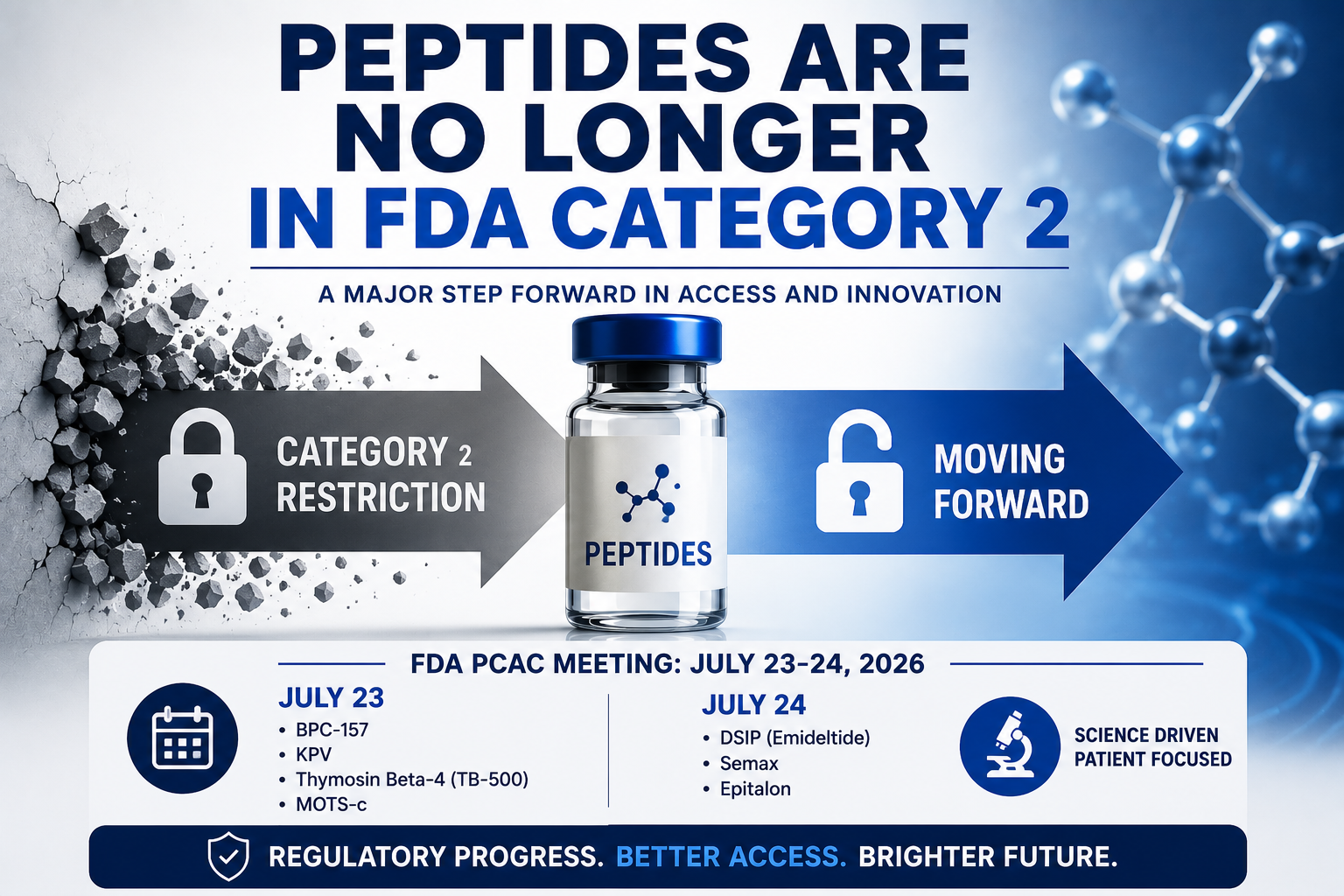
On July 23 and 24, 2026, the FDA’s Pharmacy Compounding Advisory Committee (PCAC) will meet to review several of the most well-known peptides in regenerative and longevity medicine, including BPC-157, KPV, Thymosin Beta-4 (TB-500), MOTS-c, Semax, Epitalon, and DSIP.
For patients and providers alike, these meetings represent one of the most significant regulatory developments in peptide therapy in years.
Before we talk about what happens next, it is important to understand what has already changed.
The Biggest News Already Happened
Earlier this year, the FDA removed twelve peptide bulk drug substances from Category 2 of the 503A Bulk Drug Substances List.
That may sound like regulatory jargon, but it is actually a very important development.
Category 2 was reserved for substances the FDA identified as presenting significant safety concerns or requiring additional review before they could even be considered for pharmacy compounding.
While these peptides remained in Category 2, they were effectively excluded from traditional 503A pharmacy compounding.
Today, they are no longer in that category.
It means the FDA has removed one of the largest regulatory barriers that previously prevented these compounds from moving through the formal review process.
For the first time in years, these peptides can now be evaluated on their scientific merits instead of remaining subject to a standing restriction.
That is a meaningful change.
Why the July PCAC Meeting Matters
The July 23 and 24 Pharmacy Compounding Advisory Committee meeting is the next major step in that process.
During these sessions, the committee will review the available scientific evidence for several peptides and provide recommendations to the FDA.
The committee will evaluate:
July 23
- BPC-157
- KPV
- Thymosin Beta-4 (TB-500)
- MOTS-c
July 24
- DSIP (Emideltide)
- Semax
- Epitalon
These recommendations are advisory and do not immediately change federal law. However, they represent an important milestone in determining which peptides may ultimately become available for compounding through licensed 503A pharmacies if the FDA completes the rulemaking process.
What This Could Mean for Patient Access
For patients, this is the most encouraging regulatory development we have seen in several years.
The removal from Category 2 means these peptides are no longer subject to the regulatory restriction that previously limited their path toward pharmacy compounding.
If the FDA ultimately adopts the committee’s recommendations through formal rule-making, patients could see increased access to peptide therapies prepared by licensed 503A compounding pharmacies under a valid prescription.
That would represent a significant shift from the current environment, where many patients have turned to unregulated “research peptide” vendors because legitimate pharmacy access has been extremely limited.
While the regulatory process is not complete, the direction is becoming much clearer.
This Is Progress, Not Approval
One point deserves emphasis.
The removal from Category 2 should not be interpreted as FDA approval.
The FDA has not determined that these peptides are safe or effective for treating specific medical conditions, nor has it authorized unrestricted compounding.
That distinction matters because regulatory status and clinical evidence are not the same thing.
Every peptide should still be evaluated based on the quality of the available research, the patient’s medical condition, and an individualized assessment of potential benefits and risks.
Follow the Science, Not the Headlines
The renewed interest surrounding peptides is exciting, and for good reason. Many of these compounds have shown promising results in preclinical research, while others are beginning to accumulate encouraging human data. At the same time, many questions remain unanswered, and several peptides still require larger, well-designed clinical trials before their role in medicine is fully understood.
The July PCAC meeting is an important milestone because it signals that these compounds are once again receiving serious scientific and regulatory consideration after years of being effectively sidelined.
That is good news for clinicians, researchers, and patients alike.
However, it is important to separate regulatory progress from scientific validation. A peptide should never be chosen simply because it is easier to access or because it generated attention on social media. It should be selected because the available evidence supports its use for a specific patient, under appropriate medical supervision, using medication sourced from a licensed pharmacy.
The regulatory landscape is changing quickly, but one principle has not changed: good medicine is guided by evidence, patient safety, and thoughtful clinical judgment, not headlines.


0 Comments